
Thomas County Court Records After a Jail Arrest
Court records after a jail arrest in Thomas County are created by the justice process that follows sheriff custody. The Thomas County Sheriff's Office documents the booking and custody event at the jail, and Sheriff William Joseph Smith is the sheriff named by the county. The Thomas County Attorney, Kurt Arganbright, is the prosecutor responsible for felony and misdemeanor crimes occurring in the county. When that office files a complaint, information, or other charging document, the court record becomes the official place to track charges, hearings, bond orders, amendments, dismissals, pleas, convictions, and final disposition.
The booking side and the court side should not be treated as the same record. For custody confirmation, release status, or a historical booking record, use the local jail inmate records path through the sheriff. For booking-photo availability, use the separate jail mugshots discussion because Thomas County did not publish an official mugshot gallery in the research. Court records after arrest focus on what prosecutors filed and what judges ordered after the case entered Thomas County Court or District Court.
How to Find Thomas County Court Records After an Arrest
Thomas County criminal matters can involve both the county court and district court. Thomas County Court handles misdemeanors, traffic, city ordinance cases, extraditions, juvenile and probate matters, and felony preliminary hearings. Clerk Magistrate Brenda Cochran is listed for county court at 308-645-2266. District Court handles felony criminal cases and other general-jurisdiction matters; Clerk of District Court Lorissa Hartman is listed at 308-645-2261. Both court offices use the 503 Main St courthouse address in Thedford, but their clerks and phone numbers differ, so the first practical step is identifying which court has the case.
- Confirm the arrest or custody event with the Thomas County Sheriff's Office if the question starts with a recent booking.
- Identify the likely court. Misdemeanors and felony preliminary hearings usually begin in county court; felony cases proceed in district court.
- Search JUSTICE by party name or case number after allowing for the official 24-hour lag from court entry.
- Open the case summary and review offense information, parties, register of actions, financial entries, hearings, and document images if available.
- Call the clerk when the matter is sealed, old, missing online, or close to a hearing date.
The Nebraska Judicial Branch says JUSTICE one-time case search costs $17, returns up to 30 matching cases, and gives three calendar days of access. Subscriber access is separate, with a $100 annual account charge, general searches that may be free, and $2 case-detail views. Free access to JUSTICE/SCCALES may be available at courthouse kiosks or law libraries, which matters when a user needs records but does not want a paid online search.
| JUSTICE Search Field | How It Works | Thomas County Note |
|---|---|---|
| Party name | Searches by party, usually the defendant's legal name. | Use full name and spelling from the sheriff, citation, or court notice when available. |
| Case number | Targets a known county or district court case. | Ask the sheriff or clerk for the case number if the online name search is too broad. |
| Additional criteria | Used to narrow results after too many matches. | The official guidance warns against narrowing unless name-only results exceed 30 cases. |
| Terms acknowledgment | Required before beginning the paid search. | A search with no result can still require payment. |
Official JUSTICE Case Search Source
The official Nebraska JUSTICE one-time case search is the statewide route documented for trial court case lookups, including criminal, civil, traffic, juvenile, and probate cases in Nebraska county and district courts.
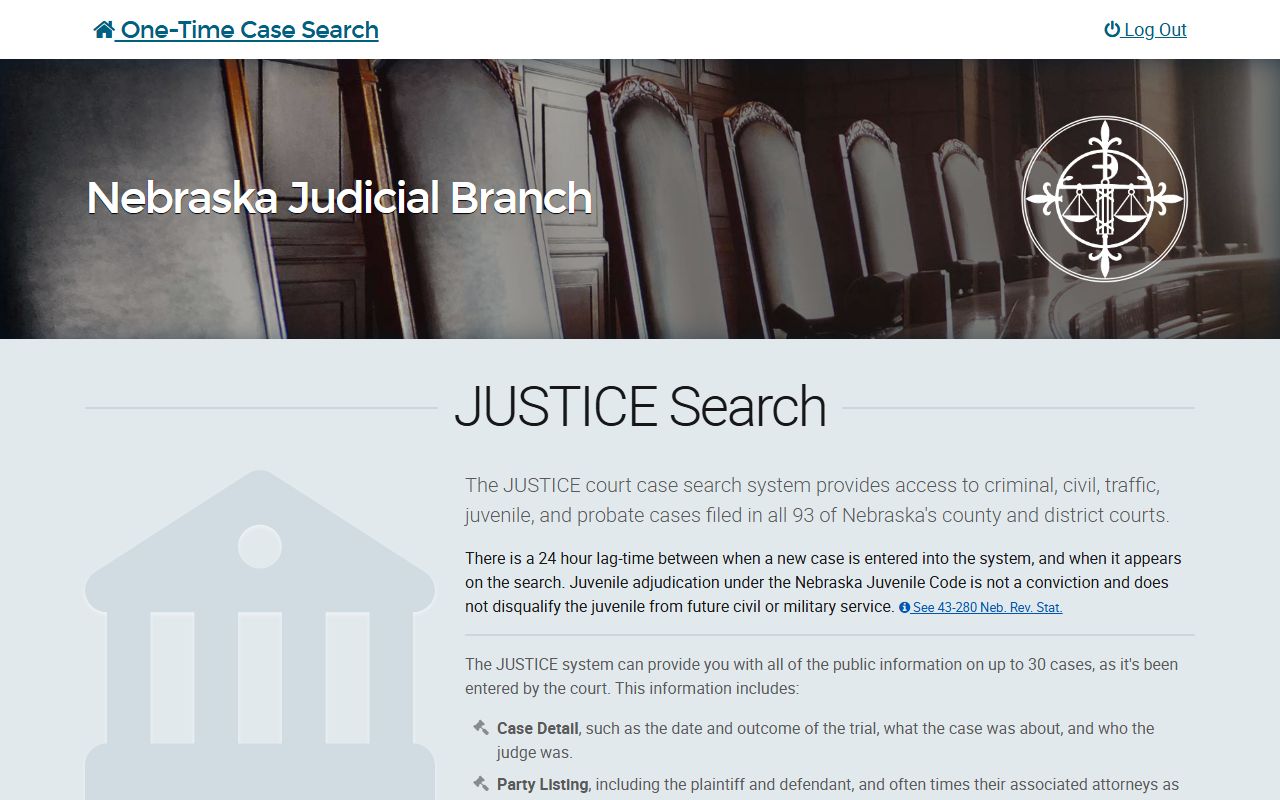
For Thomas County court records after a jail arrest, this search is most useful after the prosecutor has filed charges and the clerk has entered the case. It is not a live jail roster and does not replace a call to the sheriff for present custody or release status.
How Charges Get Filed After an Arrest: Complaint, Information, and Indictment
A booking charge is the law-enforcement reason for taking someone into custody. A filed charge is the prosecutor's court accusation. In Thomas County, the county attorney's role is the bridge between the sheriff's arrest paperwork and the court record. The complaint commonly starts a county court criminal proceeding. An information is the formal prosecutor-filed charge used in district court after preliminary proceedings or waiver. An indictment is a grand-jury charge and is less common, but it remains a possible charging method under state or federal procedure.
| Document or Stage | Filed By | Common Use | Why It Matters |
|---|---|---|---|
| Arrest or booking charge | Law enforcement | Initial custody basis | May differ from the prosecutor's final filed charge. |
| Complaint | Prosecutor | Start of many county court criminal cases | Creates the charge record that appears in the court case. |
| Information | Prosecutor | Formal district court felony charge | Often follows preliminary hearing, bind-over, or waiver. |
| Indictment | Grand jury | Serious or special cases | Starts a case by grand-jury accusation rather than prosecutor complaint alone. |
| Disposition | Court | Final case result | Shows conviction, dismissal, acquittal, diversion, amendment, or other outcome. |
Charge Status in Court Records After Arrest
Charge status changes as a case moves. A Thomas County booking entry may start with one suspected offense, while the court record later shows an amended count, reduced charge, dismissed count, added charge, plea, conviction, or acquittal. For that reason, a court-records-after-arrest search should read each count separately instead of assuming that the first booking label is the final outcome.
| Status | What It Means | How to Read It |
|---|---|---|
| Pending | The charge has not reached final disposition. | Check the next hearing, bond order, and register of actions. |
| Amended | The prosecutor or court changed the charge language or count. | Compare the original filing with the later entry before summarizing the case. |
| Reduced | The offense level or charge was lowered. | Often appears with plea negotiations or amended filings. |
| Dismissed | The charge ended without a conviction on that count. | Confirm whether other counts remained active or resulted in conviction. |
| Acquitted | The defendant was found not guilty after trial. | Do not describe the charge as a conviction. |
| Conviction | Guilt was established by plea or verdict. | Review sentencing, fines, probation, jail commitment, or later set-aside entries. |
Bond and Release After an Arrest
Bond information often starts at first appearance and may be controlled by a court order rather than a jail intake note. Nebraska law favors personal recognizance unless a judge finds that release would not reasonably assure appearance, would jeopardize evidence, or would endanger victims, witnesses, the defendant, or the community. Under Nebraska's release statutes, courts must consider the least onerous conditions and must consider ability to pay before setting bond conditions.
No official Thomas County sheriff bond-payment page was located. Before bringing money to Thedford, call the sheriff at 308-645-2221 or Thomas County Court at 308-645-2266. Ask whether payment goes to the sheriff, county court, district court, or another court office; whether the case is county or district court; whether another warrant, probation/parole hold, immigration detainer, or agency hold prevents release; and whether the bond is cash, ten-percent appearance deposit, surety, or release on recognizance.
| Bond or Release Type | How It Works in Nebraska | Thomas County Checkpoint |
|---|---|---|
| Personal recognizance | Release based on the promise to appear. | Ask the court whether conditions apply. |
| Conditional release | May include supervision, travel limits, testing, treatment, monitoring, or sobriety requirements. | Read the court order, not just the booking note. |
| Ten-percent appearance bond | Up to 10 percent may be deposited with the clerk, with statutory handling of return and costs. | Confirm payment location and acceptable methods before travel. |
| Cash or surety bond | Cash deposit or judge-approved surety secures appearance. | Check whether a surety bond is allowed for the specific order. |
| No-bond hold | A warrant, detainer, probation/parole hold, or court order can block release. | Posting local bond may not release the person until the hold clears. |
Warrants That Lead to an Arrest
No official Thomas County active warrant search, sheriff warrant list, or most-wanted page was located. A warrant can still be the reason a person is arrested and booked at the jail. An arrest warrant authorizes custody for an alleged offense. A bench warrant often follows failure to appear or failure to comply with a court order. A fugitive warrant or out-of-county warrant may involve another jurisdiction, while a probation, parole, or immigration hold may affect release after local bond is set.
For lower court bench warrants, call Thomas County Court at 308-645-2266. For felony district court warrants, call the District Court Clerk at 308-645-2261. Absence from an online source does not mean no warrant exists because Thomas County does not publish a public warrant database. Anyone trying to clear a warrant should speak with an attorney or the issuing court before appearing in person.
Court Calendar and Call-Ahead Nuance
The Nebraska Multi-Court Case Calendar can be searched for future hearings, and Thomas appears in both county and district court dropdowns. Calendar searches by date are current or future only, and the last-name field requires at least two characters. The Judicial Branch Thomas County Court page says court usually hears cases on the first Tuesday of each month at 9:00 a.m., but it also carries an important staffing note: Thomas County Court is part of a small multi-court staffing arrangement, office days can vary, and callers may be directed to the court where staff are working that day or asked for a callback number.
The practical result is simple. Do not drive to Thedford solely because a website appears to show a court location. Call ahead for hearing status, counter access, payment questions, and file review, especially around holidays, weather, or a recent arrest where the case may not yet be visible in JUSTICE.
Charges vs. Convictions
An arrest and a filed charge are accusations. They are not proof of guilt. A conviction requires a guilty plea, no-contest plea accepted by the court, or guilty verdict. Thomas County court records after an arrest may show several charges with different outcomes, so a careful reader should separate each count and disposition.
| Charge | Conviction | |
|---|---|---|
| Stage | Accusation filed in court after arrest or citation. | Final guilt finding by plea or verdict. |
| Proof level | Begins with probable cause and prosecutor filing decisions. | Requires proof beyond a reasonable doubt or a valid plea. |
| Record impact | May appear in case searches while pending or until restricted by law. | May affect sentencing, fines, probation, jail, state prison, or later set-aside requests. |
| How to verify | Read complaint, information, and register of actions. | Read judgment, sentencing entry, and final disposition. |
Sealed, Removed, and Public Court Records After Arrest
Nebraska's key criminal-history removal rule is Neb. Rev. Stat. 29-3523. It governs when certain arrest-history information must be removed from public record after events such as no charges being filed, diversion-related no-charge outcomes, qualifying dismissals, acquittals, deferred judgments, problem-solving-court dismissals, or sealing. This is not a promise that every online mention disappears from the internet, and it is not the same as saying every court file is destroyed. It is a public-dissemination and record-access rule that should be checked against the exact case outcome.
| Record Treatment | Plain Meaning | Nebraska Context |
|---|---|---|
| Public pending case | Visible while active unless restricted. | Common for adult criminal filings in JUSTICE after entry. |
| Removed from public criminal-history dissemination | Certain arrest information is no longer publicly released through criminal-history channels. | 29-3523 sets timing and outcome-based removal rules. |
| Sealed | Access is restricted by court order or statute. | Online search may not show the record, or the clerk may limit disclosure. |
| Expunged | Often used casually to mean cleared, but Nebraska rules must be read precisely. | Ask the clerk or an attorney which statute applies to the exact case. |
Background Check Considerations
Nebraska State Patrol criminal-history requests are separate from Thomas County court record searches. State Patrol public RAP sheets concern Nebraska arrests where the individual was fingerprinted, and the official research notes a $30 request route with online, mail, and in-person options. A court search may show filed charges and dispositions, while a criminal-history request may follow different redaction and dissemination rules.
Important: Casual web lookups are not consumer reports and may not be used for FCRA-covered decisions.
Restricted Court Records After an Arrest in Thomas County
Some records are not fully public. Juvenile matters, sealed cases, certain dismissed or removed criminal-history items, confidential victim or witness information, mental-health commitments, and active investigative materials may be restricted or redacted. The county public-records route is still useful, but Nebraska law allows denial, delay, redaction, cost estimates, and statutory exceptions. If a Thomas County court record is missing from JUSTICE, the next step is to call the correct clerk rather than assume the case never existed.